
Fields in Allen County Property Tax Records
Two offices feed Allen County property tax records. The Appraiser maintains the owner-roll snapshot, the legal description, property class, land and building values, and any exemption or relief context. The Treasurer adds the tax obligation and the payment side.
| Field | What It Shows | Where |
|---|---|---|
| Appraised value | County estimate of fair market value or agricultural use value | Appraiser |
| Assessed value | Appraised value multiplied by the statutory class rate | Appraiser |
| Land, building, total | Components of the parcel valuation | Appraiser and GIS fields |
| Class and tax unit | Classification and taxing geography | Appraiser |
| Bill and payment status | Tax charged, paid, or delinquent | Treasurer |
A tax bill comes from assessment and levy rules. It is not deed consideration, a sale appraisal, or proof of ownership.
Search Allen County Tax Records by the Right Field
The public tax search accepts owner name, property site address, CAMA parcel, subdivision, section/township/range, appraised-value range, and property class. An address works for a known city site. Rural tracts suit a PIN or land description better. From the result, preserve the qref, PIN, legal description, class, and tax unit.
| Search route | Best fit | Risk to check |
|---|---|---|
| Site address | Known physical property | Mailing address may differ |
| Owner name | Roll entries for one party | New deeds can precede roll updates |
| CAMA parcel or PIN | Exact parcel match | Do not substitute the shorter qref |
| Subdivision or S/T/R | City lots or rural land | Match legal-description wording |
| Class or value range | Narrow a group | Not proof of sale value |
The Kansas property-tax calendar was captured as the state timing source.
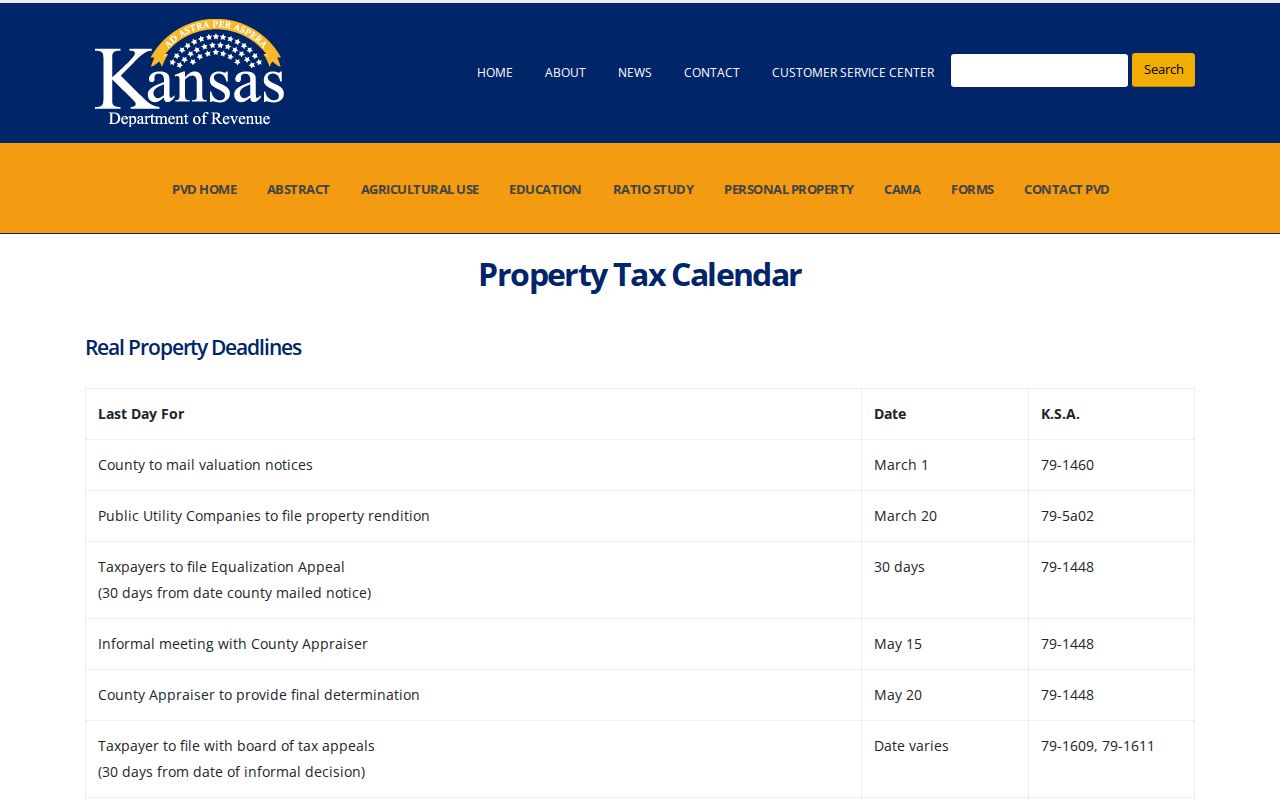
The parcel notice and current county instructions control an individual filing date.
Look Up an Allen County Property Tax Bill
Start with the Appraiser search first. Carry its identifier to the Treasurer's tax information when the parcel number is unknown. The Treasurer's office sits at 1 N Washington in Iola. Hours are Monday through Friday, 8:30 a.m. to 4:30 p.m. The phone number is 620-365-1409.
- Find the parcel by site address, owner, or CAMA parcel in the public tax search.
- Match the PIN, qref, legal description, and tax unit before opening the bill.
- Read the current charge and payment status in the Treasurer's system.
- Check county publications and recorded liens when delinquency or sale is at issue.
- Assessed value
- The value after the statutory class rate is applied.
- Mill levy
- Tax per thousand dollars of assessed value.
- Tax relief or exemption
- A rule that can change the taxable result when eligibility is met.
- Tax lien
- A recorded claim tied to unpaid tax.
Kansas Class Rates Shape Allen County Tax Values
Kansas assesses property at different rates by class. Residential property is assessed at 11.5 percent of appraised value, commercial and industrial property at 25 percent, vacant lots at 12 percent, and agricultural land at 30 percent of use value. Use value is not an acreage sale price. The working formula is simple. Appraised value multiplied by the class rate gives assessed value. Tax equals assessed value times the mill levy, divided by 1,000. Exemptions or abatements can change the taxable outcome. None of that math turns the appraised figure into a sale price.
The 2026 Allen County Market Study Is Not a Sale Index
The 2026 market study covers Allen County. Post-1945 residential property moved 6.8 percent. Pre-1946 residential rose 6.25 percent, commercial 6.7 percent, and vacant land 2.7 percent. Agricultural use-value changes arrive through the state process under K.S.A. 79-1476. These are study inputs. No parcel is promised the countywide percentage. A parcel's own fields, class, characteristics, and notice control its assessment record, while a deed's consideration remains a separate evidence layer.
Allen County Delinquency and Tax Sale Notices
The county Current Publications page listed a June 3, 2026 Allen County Tax Sale. An August 3, 2026 Delinquent Real Estate publication appeared as well. Rely on the dated notice. It supplies the parcel list, legal description, and instructions. A publication is a process step. It does not prove title transferred, so also check Treasurer status, the Register of Deeds for liens or resulting instruments, and any related court file. Keep the figures separate. A sheriff sale amount, tax sale amount, deed consideration, and later market sale are different numbers.
Separate Kansas Assessment Classes
Kansas multiplies appraised value by a statutory assessment rate. Residential property generally uses 11.5 percent, commercial and industrial 25 percent, vacant lots 12 percent, and agricultural land 30 percent of use value. Use value is not the likely sale price of acreage. Exemptions and abatements can shift the taxable result. The market estimate itself stays put. After classification, tax equals assessed value times the mill levy, divided by 1,000. Keep three values separate on an Allen County card. Appraised, assessed, and tax answer different questions. A recorded deed's consideration belongs to another evidence layer and should never replace the Appraiser's estimate.
Track the Kansas Property Tax Calendar
The state calendar sends valuation notices around March 1. A 30-day equalization-appeal window follows, with informal meetings in May. Appraisers certify values by June 1. County rolls are certified November 1. Tax statements arrive around December 1, and payments fall due December 20 and May 10. Parcel notices control. Confirm the current date and deadline on the Allen County document, and pair it with the Kansas property-tax calendar, which sets statewide timing without replacing a local notice. Keep the notice date, valuation year, parcel number, class, and appeal instructions together, because waiting for a tax bill can miss the earlier valuation window.
Interpret Allen County's 2026 Market Study
The county's 2026 study reports trend inputs for the assessment year. Post-1945 residential sits at 6.8 percent. Pre-1946 residential is 6.25 percent, commercial 6.7 percent. Vacant land carries 2.7 percent. Agricultural use-value changes come through the state each year under K.S.A. 79-1476. These are study inputs. They are not promises that every parcel appreciated by the listed percentage. Use it to grasp countywide valuation. Then return to the parcel card and notice, treating any sale price or deed consideration as supporting evidence rather than a match for assessed or appraised value.
Distinguish Delinquency Notices From the Tax Roll
Two dated items ran in Allen County Current Publications. One is a June 3, 2026 tax sale. The other is an August 3, 2026 delinquent-real-estate notice. Each marks one stage in the collection process. Read them alongside their redemption and sale instructions. Neither is a lasting statement of a parcel's standing in Allen County property records.
Roles stay separate. The Treasurer collects and distributes real-estate and personal-property taxes. The Appraiser keeps the valuation record. Call the Treasurer at 620-365-1409, Monday through Friday, 8:30 a.m. to 4:30 p.m. Ask to confirm payment or delinquency. A paid tax bill proves nothing about ownership or other recorded interests.
Challenge an Allen County Property Assessment
Kansas sets the appeal calendar. Valuation notices go out around March 1, followed by a 30-day equalization window. Informal meetings come in May. Appraiser certification lands on June 1, and the county tax roll is certified November 1. The current notice states the exact parcel deadline. It also lists the filing method for your Allen County property search.
Good evidence makes the case. Bring the parcel card, the correct class and characteristics, and recent comparable sales. Also bring photographs and any records showing factual errors. The Allen County Appraiser at 620-365-1415 can confirm the active process. A prior year's date may mislead.
Watch the notice date. The Kansas equalization window is generally 30 days, but the current Allen County valuation notice controls the filing deadline.
Get Allen County Tax Records Offline
Online portals are not the only route. At the courthouse, the Appraiser explains parcel cards, classifications, and valuation records. The Treasurer handles bills and payment status. Legacy Allen County materials list copy, query, and map charges. Verify current costs before requesting records.
When non-exempt records sit outside the portals, the Kansas Open Records Act offers a path. Direct a KORA request to the county custodian. The custodian must allow inspection of open records while charging lawful fees and honoring exemptions. Keep it simple: a parcel number, a record type, and a date range.